Monday, 21 November 2011

New Technology and Video game distribution

Before designing and creating my character, I decided to do a little research into distribution, something I have already touched on a little in my ‘Indie game and development’ blog post. I decided it would be a worthwhile choice to go a little more in depth on how video games are distributed and how new technology is helping to shape the industry. This research will be key when it comes to designing my final product
.
Distribution of video games has changed drastically in the last five years. These changes are revolutionising the gaming industry by allowing independent game developers as well as much larger ones to make profit and effectively get their games onto the market.
Digital distribution is one of the main aspects in which new technology is affecting the industry. In the past, games would have been transferred onto a cartridge or disk, packaged and then sold to stores. The cost of doing this meant that only developers with a publisher could reach the main market of gamers by selling their games on the high street at shops such as HMV or GAME.  For an indie game developer, this would be far too expensive and therefore it would not be viable for them to sell their games this way, and if they were to, it would be very small scale with not very many stores stocking them.
Digital Distribution such as itunes, Steam, Xbox Live Market Place, Nintendo Channels and the Playstation store have allowed indie developers such as Re-logic, Mojang and many others to distribute their games and become popular and established.

 Terraria, released in May of 2011 and developed by Re-Logic, and Minecraft, released in its Beta stages in 2009 and which is soon to be released in full are both very good examples of how digital distribution is slowly helping shape the industry.  Both of these games I have previously mentioned in my ‘Indie game and development’ blog post, due to their large scale popularity, even going on to overtake some commercial games.
Portable gaming is something that has become increasingly popular lately, iPhones and iPods are being used to host games such as Angry birds, this game has gone from success to success and is even producing a soft toy line now.
Following the brief, I will be producing my game as both a developer and publisher, releasing it to the market as a packaged disk, although, technically being an indie developer it would be more advisable for me to only distribute through Steam or another direct download website. Braid is a good example of an indie game that is both publishing through digital distribution, but also being distributed traditionally as a packaged disk. I think following the direction Braid has gone in would be the most advisable route for my game.
Next, I will be designing the main characters for my game, ZED900 and Wren. I will need to think carefully about character designs, making sure I meet my target audience.

Monday, 14 November 2011

Video Game Synopsis and Development Notes

Since looking at some of the most iconic video game characters and after careful consideration about genre conventions of a platformer game, I started work on a synopsis, detailing the storyline and several game play elements of my game. These can both be found below.

Synopsis –
After finding an item powerful enough to change the world almost literally, using it for the good or bad is a choice teenage nerd Wren will have to work out for himself. But when a rip in the dimensions causes an unknown force to leak into his world, sending it spiraling into paralysis and transporting him to an unknown area, he has no choice but to work on saving it.
Now stranded in an empty, desolate dimension with only an Artificially Intelligent bat like creature named ZED900 to guide him, Wren has a paralyzed world in his hands, along with the mysterious dimension bending gear, which he has no idea how to use. Eventually, using the help of insecure ZED, who is unsure of himself 99% of the time, Wren, with great difficulty learns to use this power of the gear to his advantage.
Wren must navigate between 20 very different dimensions, collecting dark dew from each, which can eventually be combined and reversed to restore the world from paralysis.
With over 20 levels of life changing gameplay, this slightly retro, slide scrolling puzzler platformer will turn your world upside down!

Development notes –
The basis of Gear Rift’s game play revolves around the player being able to turn the platforms and environments within the game, upside down.
Having a set button such as CTRL or Shift allows the player to use the power of the Gear, flipping the environment. This lets players navigate past area’s they would not have been able to get past before. An example of this would be, having a spike or something similar that the player cannot jump over, in the way. This spike reaching from the floor, does not quite reach the ceiling so there is a gap, however it is too high to jump over. Using the Gear to flip the scenery and all platforms allows the player to simply walk past the spike, which is now descending from the ceiling instead of growing from the floor. Once the player has walked past, releasing shift will return the world to normal, leaving the player the other side of the obstacle.
This game will contain no enemies. This is due to the world being in paralysis and the player along with ZED900 being the only non frozen characters in the game. Instead the player faces dangers such as pits, lava and other environmental dangers. The game has 20 main levels of varying difficulty, all must be navigated and every other level will contain a ‘dark dew’, the item required to restore planet earth, repair the rip between dimensions and send Wren back home.
This game will be largely reliant on cut scenes to tell the player of any major events that occur in the game (For example, Wren finding the gear). These will also be used to show ZED900 communicating with the character and give the audience a sense of what is really going on.
This game will be released for the PC and is aimed at retro gamers between the ages of 15 and 20. The game will have a rating of 3+ or 7+ due to containing no violence, bad language, gore ect and by having this, it will allow me to aim my game at the largest group of people.

Now I have completed this, I feel it would be a worthwhile choice to draw out design and personality sheets for my two characters, Wren and ZED900. This will help me when creating the sprites and animations for my games trailer/TV advertisement and posters.

Wednesday, 9 November 2011

25 Most Iconic Video Game Characters

I chose to look at 25 of the most iconic video game characters and the games they appear in. I created a Prezi to show my research, as it is harnessing new technology, something I feel is important for my blog.


Wednesday, 2 November 2011

Video Game Genres and Associated Conventions

When creating my survey monkey I made reference to genre. Here I listed six of the most popular genres in the video game industry, Action, Adventure, First Person Shooter, Platformer, Puzzle and RPG. There are over 40 genres of video games; many of these however, are either not common or not used very often, I narrowed down the 6 most played genres for this. Below, I will list some of the conventions of these genres of game. Platformer is one I will be going into further detail on because this was the most popular in terms of votes for my survey.

Action – Action games are fast paced games, usually with little storyline, these just throw the player into the action. In these games, the player typically takes the role of a protagonist that navigates game levels, usually collecting objects, battling enemies and battling bosses.


Adventure – These games are largely about exploring a new area or land, usually with a mission in mind. Okami, one of the games I studied for my trailer analyses is a good example of an adventure game, where the protagonist takes on the mission to restore the land from evil.


First Person Shooter – These games are set in the first person, directly putting the player into the shoes of whoever they are playing as. As the name would suggest, these games primarily involve the player having a projectile weapon and a target to shoot. This may be a person, monster or an object. Usually these games will have a mission or an invasion plot that the player has to follow. These games are often very realistic, graphics wise, with no non diegetic music overlayed.


Platformer – Platformer games are commonly 2D and are characterized by having players jump from platform to platform, over and under obstacles, usually collecting something or clearing enemies. There are two types of platform game, single screen and scrolling. Single screen being games such as Donkey Kong where you can see all platforms in the level whereas scrolling includes games such as Super Mario where you only see select parts of the screen and it scrolls with the character. The characters for platformer games are often friendly looking, unlikely heroes (Mario and Donkey Kong are good examples of this as not many would expect an ape or a plumber to become a hero). An 8bit one minute or so loop of music is usually played over the top of the game this helping add to the style, character and setting and sets the mood of the game. It is common for platformer games to have light hearted and friendly music to draw players in. Settings for platformer games are varied and can range from an underwater dungeon to a forest, where the game is set is majorly up to the imagination of the creator.


Puzzle – Games that involve a large amount of strategy and problem solving are considered Puzzlers, although many action or adventure games have puzzle solving aspects within them, a game is only truly considered a puzzler when this is the main aspect of the game play. The most popular puzzle game is Tetris, which involves the player moving and piling up falling blocks. Minesweeper, another popular game is also part of the puzzler genre.


RPG – This stands for Role Playing Game, these games traditionally put the player in the place of a character within the game, placing you in the role of someone else. Role playing games typically rely on a highly developed story and vivid, imaginary environments in which you play in. Most role playing games will contain levels, allowing the character to gain experience to advance through it.

Typically, role playing games have the player working on saving the world, a person, or generally just placing the player in a hero role. Games such as Pokemon and Final Fantasy are exceptions of this. Exploration is another big part of the typical role playing game; this is linked well to the storyline, allowing the player to explore the world they have been placed in, whilst still being linked to a plot and being required to do quests.


The majority of people that took my survey chose either Adventure or Platformer, these games are often paired together and I will be sure to follow these conventions when coming up with concepts and designs for my game. Next I will be looking at some of the most popular video game characters, in preparation for creating my own protagonist.

Tuesday, 25 October 2011

Survey Monkey Results and Analysis

After posting the Survey Monkey embed on my blog, I received two more completed surveys. With 27 surveys completed I feel analysing the results to learn about my target audience is the best option as the number of completed surveys is enough to give me significant insight into the target audience of the game I will be designing and marketing.

Below are the results to my survey and some conclusions that can be made by looking at them.


My first question, 'What is your gender?' was answered with an almost 50/50 split between the two sexes. This indicates that my target audience, the people I should be aiming my game at, are not of a particular gender. I should try and reflect this in my game by not aiming it too much at males (using Mulveys ‘Male Gaze’ or making it too action and fighting orientated) or at females (Making it too stereotypically pink and fluffy). It is a well known fact that the large majority of gamers are male, with most games (series like Call of Duty, Just Cause or Battlefield) aimed at a male audience. Even players of games such as Pokemon, Spyro, Mario and other supposedly ‘gender neutral’ games have a majority male player base.

I think the reason for this majorly male dominated industry is because game developers do not know what girls want from a game. Most females are not interested in the war games that males tend to go for, but most do not want overly stereotyped games, such as the ‘imagine’ series either. Many potential female gamers are put off gaming due to this.

Game developers are more likely to aim their games at males as it is much less risky and more predictable for them. Call of Duty Modern Warfare 3 is a prime example of this, it is set to be released early November and can guarantee a sale of millions within the first day. The Call of Duty series is well known by male gamers and although the game play in each game doesn’t differ much, they have become a huge hit with teenage guys worldwide.

In recent years, game developers are trying to reach out more to female audiences; games such as Fable are including a female character option, allowing girls to get more involved within the games and hopefully evening out the numbers in the future.

Making my game relative to both females and males is something I would like to concentrate on when planning my game; this will keep it relevant to my target audiences.


My second question was ‘What is your age category’, it can clearly be seen by the results that all but two of the gamers answering this questionnaire were under 24 years of age.

I had predicted this result because under 24 year olds are more likely to have free time on their hands than any other age group. I will need to make sure that the contents within my game will not cause it to go above a 16 ESRB rating to keep it relative to my target audience, I think a 3+ or 7+ rating for my game would be the most relevant, making it playable by all age groups and keeping violence, sexual themes and bad language to a minimum.

Stanley Halls ‘storm and stress’ model can be applied here. Hall said that adolescence is a time of storm and stress, when all young people go through some degree of emotional and behavioural upheaval, before establishing a more stable equilibrium in adulthood. He stated that depression is a common mood in teens and suggested that criminal activity would increase between the ages of 12 and 24. He talked about heightened sensation seeking, stating ‘youth must have excitement and if this be not at hand in the form of moral and intellectual enthusiasms it is more prone to be sought in sex or drink’

This links well with my survey results; many popular games on the market today are violent and involve crime of some sort. Games such as these are popular with youths possibly because of Stanley Halls theory; they are exciting and thrilling therefore youth seek them as a sensation.

Moral panics about video games increasing aggression and crime rates is something I will be further researching, in relation to Halls theory of adolescence.

 
My third question was about social grades, linking to the theories I had discussed in a previous blog post. The majority of gamers that took my survey fitted into category E (Students, Pensioners or the unemployed) this was also to be expected, due to these people having the most free time on their hands.


My forth question was set to find out which social value groups my audience would most likely fit into. I had previously predicted that ‘Self Actualisers’ and ‘Disconnected’ would be the majority, this was not the case, with ‘Strivers’ and ‘Self Actualisers’ coming out top. I think the reason for this would be because, Strivers are looking for acceptance and when playing multiplayer games and being in a group like that, acceptance would be important for a player. ‘Self Actualisers’ was one of the value groups I predicted would come out highly in my questionnaire, this was the highest answer and I feel this is probably because when playing a game, exploring is often a big part, so gamers are more likely to be people who explore change enthusiastically rather than someone that would rather stick to their comfort zones.


Question five showed that the overwhelming majority of people taking my questionnaire played games at least once a day or every few days, this makes the results of my questionnaire relevant and shows I am appealing to the right target audience, under 24 year old gamers.


My sixth question shows that the majority of the gamers I questioned played games for entertainment, second to escapism. None of these people played games to ‘fit in’, only a couple played for stress relief and one played for Thrill and Excitement. This goes against my explanation, using Stanley Halls theory, on why young people play games. I will need to apply these results to my final product, making it as entertaining to my audience as possible.


When asked what their favourite genre of video game was, most chose platformer, with adventure coming in close second. I will be doing more research into genres on a future blog post, but I feel it would be best to create a platformer or adventure style game, in keeping with what my audience want. 


The majority of people that took my survey were PC gamers with 12 out of 27 choosing that option. Nintendo DS was the second most popular console with 6 people choosing it. From this, I can conclude that the majority of my target audience would prefer my game to be made for the PC, this will be something I will need to think about when it comes to planning and designing my final products. 


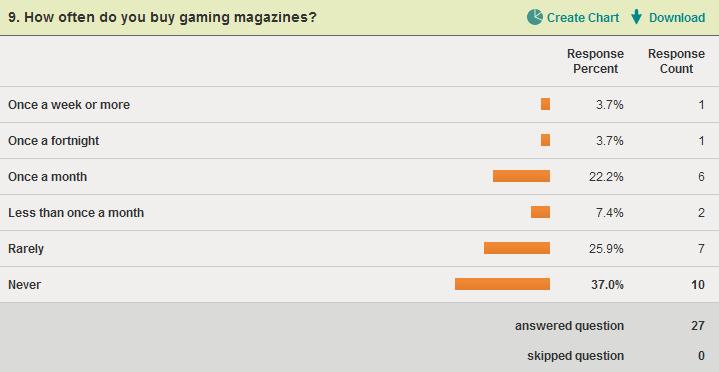
A large amount of people that took my survey never bought gaming magazines. A gaming magazine would be where my advertisement is most likely to be shown, but despite a lot of people not buying them, a significant amount still bought them once a month, on occasion or rarely, meaning it would still be viable to create the advertisement with a gaming magazine in mind. 


Finally, my last question asked whether people paid attention to gaming magazine and TV advertisements came out with a high majority yes, meaning that advertising in these ways would help get my game known by my audiences.

Overall, I feel my Survey Monkey has been a valuable resource when finding out what my target audience is and will hopefully help me better adhere to these people when designing and creating my final piece.

Next I will be conducting some research into already existing, iconic video game characters and do a little research into genre and what conventions I will need to be following when creating a game of a particular genre.

Sunday, 16 October 2011

Survey Monkey

Below is my Survey Monkey, It contains 10 questions that I feel will help me define a target audience, but some that will also will help me when making crucial decisions for my game such as Genre and Platform.
I posted this survey in two places I knew it'd get attention from gamers, the first being my DeviantART account and the second being my Facebook.

Above is my DeviantART post, asking for people to fill it in and below is my post on Facebook

Below is the embed for my survey, I recieved 25 responses from posting this survey in the two places I did and now I will need to analyse the results to help me attain to a target audience when producing my final product.


Create your free online surveys with SurveyMonkey, the world's leading questionnaire tool.

Monday, 10 October 2011

Target Audience Overview

Having the right target audience is a very important part of advertising a product. Making sure I am aiming my game at the right audience is something I will need to establish to ensure its success.

There are two main theories called upon in advertising. Maslow’s published paper, ‘A theory of human motivation’ which has been adapted to marketing, and theory being social grade theory.

Maslow’s theory outlined that people have a hierarchy of needs, these needs are often pinpointed by marketers who are quick to use these needs to as a means to sell their products. The five main needs, stated by Maslow are as follows – Self Actualization, Esteem, Love/Belonging, Safety and Physiological.     These needs were converted into a table of social value groups created from a study of UK values and change. The insight value group scale claims to be an accurate representation of the groups that exist in the UK today. The official insight into social value group.ltd table is shown below.


I think when it comes to gamers, the majority would fit into the disconnected or self actualisers. I think this because many gamers play games to escape reality (known as escapism) and because many other groups of gamers will play for the thrill of exploring a new place and figuring things out for themselves.
Katz and Blumler established the audience uses and gratifications theory, they claimed that audience uses media for a variety of purposes such as Diversion (Escapism), Personal Identity (self understanding), Surveillance (information retrieval) and personal relationships (conversation and companionship).
However, I do not have any evidence to support these theories, so I will be addressing social value groups in my questionnaire and finding out if I am right to aim my advertising about people in these groups.

The second theory applied to advertising is social grade theory. This theory states that depending on the social grade (correlated with earnings) is how likely they are to buy a product. For example, a student with not much time on their hands would be more likely to buy a video game than a doctor, who is working full time. I think students or those in semi skilled or manual jobs are the most likely to play video games, due to having more time on their hands.

The official social grade chart, based on social status is shown below.


Social grade will be another thing I will be researching during my audience research, this will help me test this theory and will help me better apply my product to a target audience.

Next, I will be conducting a survey, using www.Surveymonkey.com and analysing these results to see what I will need to be consider during the designing and making of my game, but also to see if these audience theories can be applied.